Air forces increasingly store fighter aircraft fully fueled and mission-ready inside hangars, where they are shielded from weather, harder to observe by satellite, and ready for rapid response. Fire protection in these facilities therefore has to both protect the aircraft and keep them available.
Accidental discharge from foam-based systems can leave several aircraft temporarily unavailable. Ignitable Liquid Drainage Floor Assemblies (ILDFA) remove spilled fuel through the floor before it can accumulate and ignite, providing fuel fire protection with no discharge event that could affect aircraft readiness.
Hangar Foam Discharge and Aircraft Readiness
A foam discharge can leave aircraft in a hangar bay temporarily unavailable. Foam suppression systems use flame detectors to trigger a full discharge, so a single detector activation reaches every aircraft in the bay.
A detector activation does not require a fire inside the hangar. Explosions or fires elsewhere on the airbase can activate flame detectors in nearby hangars, and nearby fires, flash events, or burning debris can trigger the system when no fuel spill or aircraft fire exists inside. When that happens, the hangar foam discharge can affect all aircraft in the bay.
Intentional activation is a second route to the same result. A low-cost drone carrying a small incendiary device, flown into a hangar, could trigger the discharge and leave multiple aircraft temporarily non-operational.
ILDFA has no flame detectors and no foam discharge, so external fire events and intentional activation cannot activate the system.
Why Fighter Aircraft Are Kept in Hangars
Rising geopolitical tensions and advances in satellite surveillance have changed how fighter aircraft are housed and maintained, and air forces increasingly keep aircraft inside hangars because hangars provide:
- Reduced satellite visibility
- Protection from weather exposure
- Improved maintenance conditions
- Faster launch readiness
Aircraft in these facilities are often maintained in near-launch condition, with full fuel loads and rapid start capability, which raises the importance of hangar infrastructure that cannot inadvertently disable aircraft availability.
How ILDFA Prevents Fuel Fires Before Ignition
A spill drains away before it can become a fire. The drainage floor assembly captures spilled fuel and removes it immediately, which addresses the hazard at its source, and removing the fuel before a flammable pool forms reduces the probability of a sustained fuel fire inside the hangar.
The system is passive, with no flame detectors, heat detection systems, foam discharge equipment, or chemical suppression agents, so it cannot cause an accidental suppression event.
Engine Start and Warm-Up Inside the Hangar
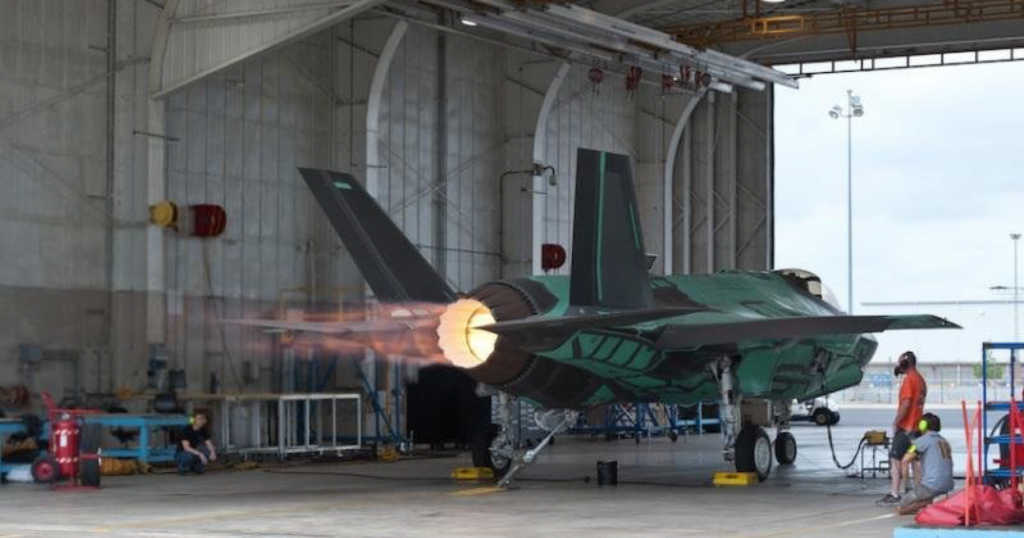
Crews can start and warm up engines inside the hangar when the hangar layout allows. Foam systems triggered by flame detection can restrict these procedures. Because ILDFA uses passive drainage and has no flame detection, engine start and warm-up carry no risk of triggering a suppression system, which supports readiness in colder climates, where engine warm-up before taxi is often required.
Cold and Desert Climate Performance
Sites with limited water can still be protected, because ILDFA requires approximately 750 liters per minute (200 gallons per minute) in desert environments, compared with the thousands of liters per minute typically required by foam suppression systems. That flow rate typically needs a water supply line of 3 inches or smaller, which reduces infrastructure requirements.
In cold climates, the system uses primarily dry piping and minimal water, which reduces exposure to freezing conditions. For remote installations where water infrastructure is limited or expensive to install, fully self-contained ILDFA systems with integrated water supply and containment are also available.
Durability and Maintenance
The floor is designed to outlast the hangar. Marine-grade aluminum alloy resists corrosion over a long service life, and because the system has few moving components and no complex suppression equipment, maintenance requirements are low. ILDFA systems also carry a 10-year warranty.
Deployment and Approvals
ILDFA systems have been installed since 2020 in hangars that support F-16, F-18, and F-35 aircraft. Installations, completed or in progress, include desert sites, cold climate bases, and northern Canadian facilities with extreme winter conditions.
ILDFA is approved under NFPA 409 in the 2022 and 2026 editions and is FM Approved. It is used by multiple military organizations, including the United States Navy and the Royal Canadian Air Force.
Fire Protection and Aircraft Availability
ILDFA protects fighter aircraft hangars by removing spilled fuel before it ignites, so no discharge event can take aircraft out of service.
Contact our team to discuss fire protection for your facility.