When it comes to hangar fire protection, water infrastructure often drives the biggest costs.
That reality leaves operators with a clear choice: spend thousands on water supply with ILDFA, or millions on water infrastructure with SFFF or high expansion foam.
- ILDFA requires a maximum of 200 GPM, regardless of hangar size
- Foam systems require increasing water demand as hangar size grows, reaching nearly 10,000 GPM for large Group I hangars
- Foam systems require large fire pumps, complex distribution piping, and extensive underground water infrastructure. In some cases, dedicated water storage tanks are required
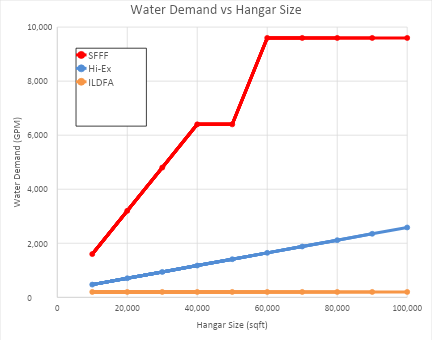
Foam systems often require an extremely high water demand that is driven
directly by hangar size, triggering a cascade of hidden costs. Oversized fire pumps, large underground mains, dedicated pump rooms, and on-site water storage tanks are common requirements. These elements are rarely anticipated early in design, yet they routinely become the primary drivers of both cost and schedule once foam is selected. What begins as a fire protection decision quickly expands into a major civil, mechanical, and electrical project.
In one real-world example, a high-expansion foam system for a 185,000-sf facility required two 75,000-gallon water storage tanks, multiple 2,500-GPM fire pumps, and large-diameter underground piping. While the foam system was only one component of the design, the supporting water infrastructure became a project of its own.
By contrast, ILDFA caps total water demand at 200 GPM, regardless of hangar size. No scaling, no storage tanks, and no oversized pumps.
Foam systems add complexity. ILDFA keeps things simple.
Reminder: Join Our Upcoming Webinar on Proven Reliability through Rigorous Evaluation
ILDFA is not a theoretical solution. It is a tested, validated, and continuously proven technology.
Join us to learn how Safespill’s ILDFA was rigorously tested and validated for real-world hangar conditions. We will cover full-scale fire testing, FMEA, and FM Approvals certification, and show how the system’s structural, operational, and fire performance were proven.
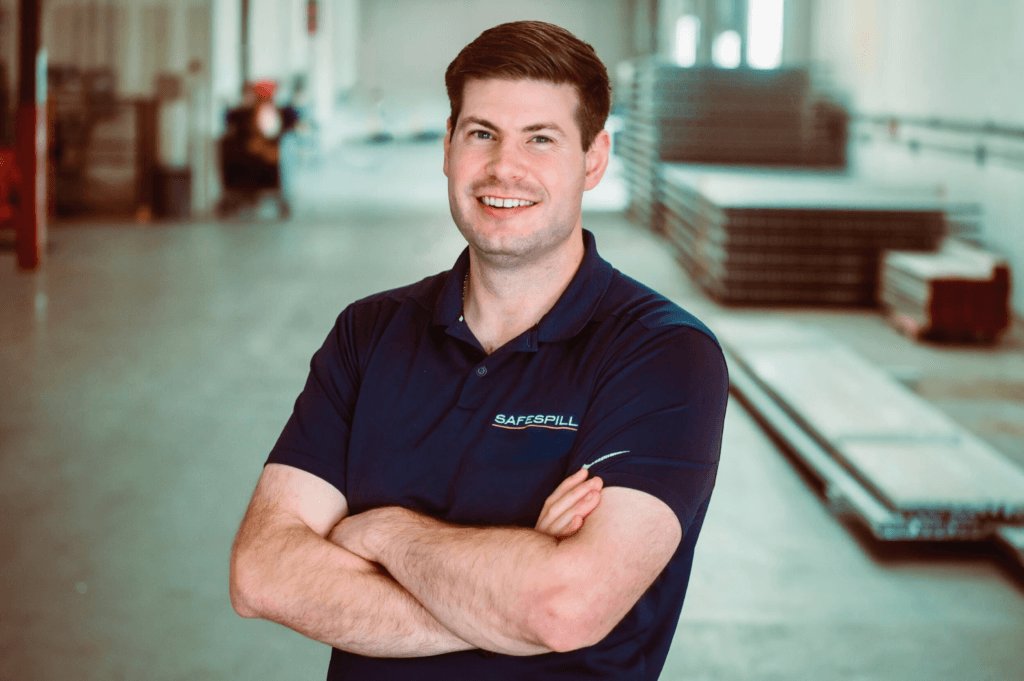
Presenter:
Kyle Giubbini
Lead Product Engineer, Safespill
NFPA 409 Technical Committee Member
Follow me on LinkedIn
Tuesday, January 13th 1:00–2:30 PM CST