
Oil-Water Separator and Containment Options for ILDFA Aircraft Hangar Installations
An Ignitable Liquid Drainage Floor Assembly (ILDFA) uses water and gravity instead of foam, so the only substances that need containment or oil-water separator treatment are water and hydrocarbons from a potential fuel spill. How that runoff is handled is one of the most consequential design decisions in an aircraft hangar project.
Key Takeaways
- ILDFA discharge is water mixed with hydrocarbons. The industry term for treatment equipment is "oil-water separator," even though runoff is rarely pure oil.
- 3 standards govern sizing: UFC 4-211-01 Change 4, NFPA 409 (2026 Edition), and FM Datasheet 7-93.
- Designs must handle worst-case fuel discharges of up to 200 GPM for smaller aircraft and 400 GPM for larger aircraft, plus 200 GPM of flushing water.
- Under UFC 4-211-01, minimum containment tank volume is 15,000 gallons (56,775 L). NFPA 409 and FM 7-93 add sprinkler water to the design basis, which increases required capacity.
- There are 7 viable configurations, ranging from underground tanks to above-ground tanks, full-capacity separators, hybrids, and closed-loop water reuse.
- Early coordination between environmental, fire protection, and civil engineering teams leads to the best design integration.
How ILDFA Handles Spills and Runoff
Most hangar spills are routine. Purging fuel lines, refueling, and replacing components can release anywhere from a few milliliters to several gallons. ILDFA captures and drains these spills at the source, which reduces cleanup time and limits disruption to hangar operations. The same system supports in-hangar aircraft washing and other wet maintenance activities.
The system must also be designed for the worst case, such as a large fuel discharge combined with flushing water, and in some codes, sprinkler water. How that volume is contained or treated is what separates the 7 options below.

ILDFA Containment Tank Sizing: NFPA 409, UFC 4-211-01, and FM 7-93
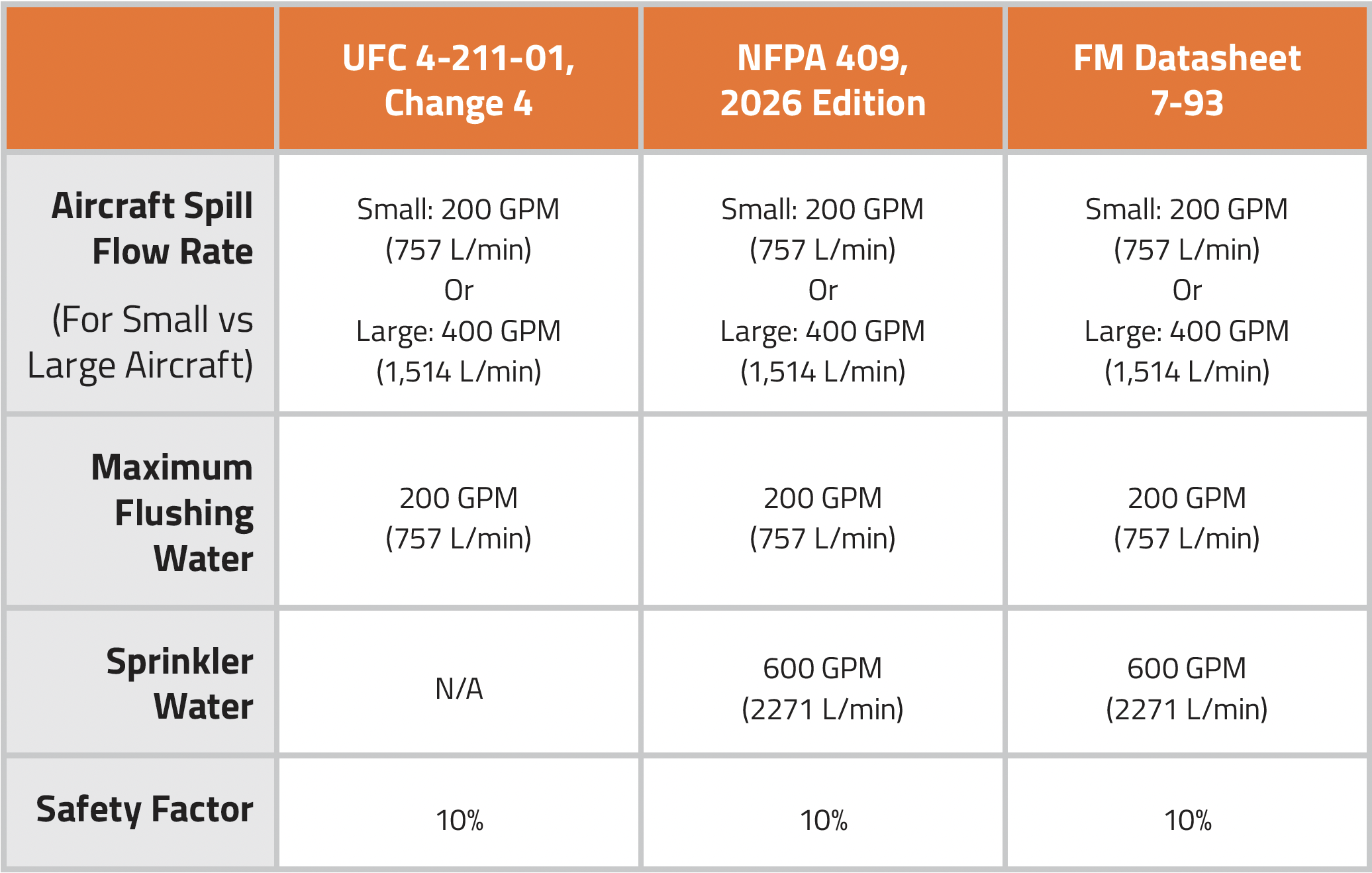
Containment volume is based on the largest potential spill, flushing water flow, any sprinkler water the code requires, event duration, and a safety factor. The 3 governing standards treat these inputs differently.
ILDFA Oil-Water Separator Sizing for Aircraft Hangars
A separator that treats discharge in real time is sized for peak flow. Design flow is the aircraft spill flow rate plus flushing water and, where required, sprinkler water, with a 10% safety factor in all 3 standards.
Aircraft SizeSmall Aircraft |
UFC 4-211-01440 GPM (1,665 L/min) |
NFPA 409 or FM 7-931,100 GPM (4,165 L/min) |
| Large Aircraft | 660 GPM (2,500 L/min) | 1,320 GPM (5,000 L/min) |
How to Choose a Configuration
No single option fits every hangar. 4 questions usually narrow the field quickly.
Bringing environmental, fire protection, and civil engineering teams together early lets the containment strategy and the ILDFA be designed as one system.
Which code governs the project?
What do site conditions allow?
What is the maintenance appetite?
Are sustainability goals part of the project?
Frequently Asked Questions
What is an oil-water separator in an ILDFA installation?
It is the treatment unit that separates hydrocarbons from the water in ILDFA discharge. Runoff is typically water mixed with hydrocarbons rather than pure oil, but "oil-water separator" is the standard industry term.
How are fuel spills contained in an aircraft hangar with an ILDFA?
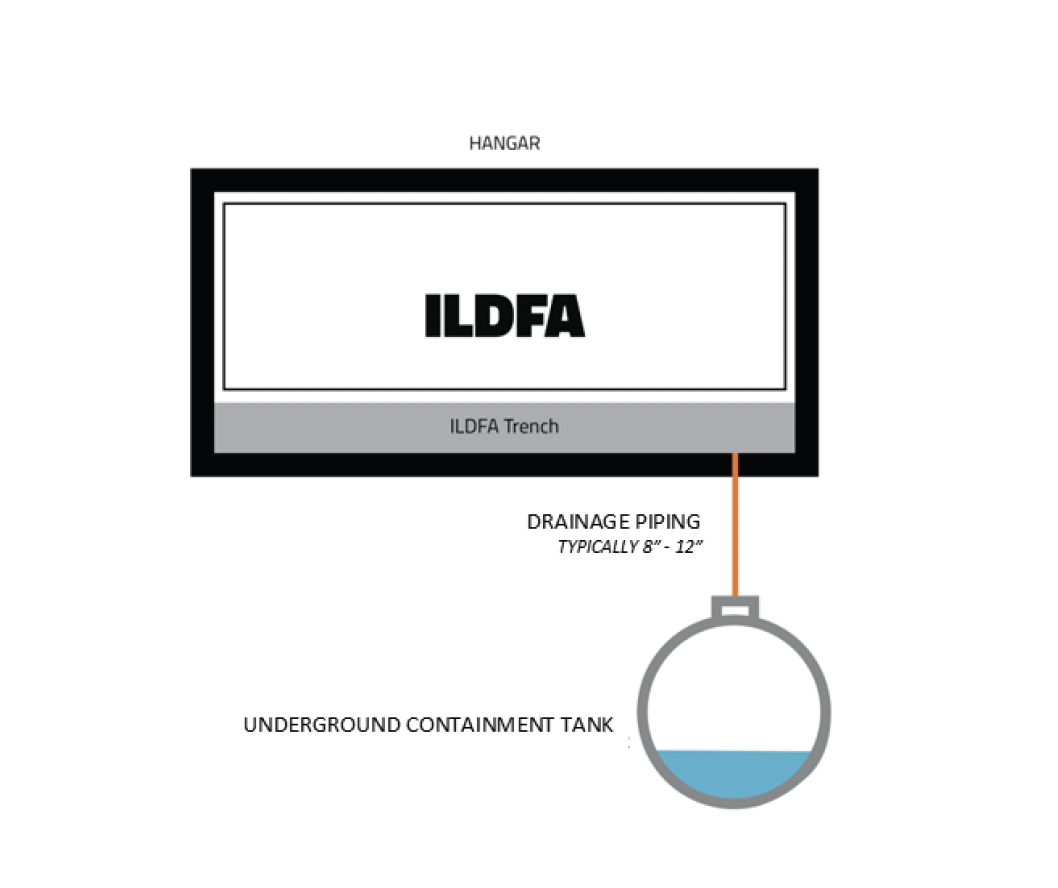
Routine spills are captured and drained at the source. For worst-case discharges, the drainage piping routes flow to an oil-water separator, a containment tank, or a combination of both, depending on the configuration chosen.
How does NFPA 409 affect hangar containment sizing?
NFPA 409 (2026 Edition) adds 600 GPM (2,271 L/min) of sprinkler water to the design basis, uses a 45 minute event duration, and applies a 10% safety factor. Together with 200 GPM of flushing water, this requires more capacity than UFC 4-211-01, with tanks up to 60,000 gallons in some designs.
How does FM 7-93 affect hangar containment?
FM Datasheet 7-93 uses the same 200 GPM of flushing water and 600 GPM of sprinkler water as NFPA 409, but with a 60 minute event duration, which increases the containment volume. Tanks up to 60,000 gallons may be needed.
What size UL 142 tank is used for ILDFA containment?
In the hybrid above-ground configuration (Option 6), a 15,000 gallon (57,000 L) UL-142 tank captures daily ILDFA discharge and small flushing events. An overflow valve diverts flow to secondary containment when the tank reaches capacity.
How large does a containment tank need to be for an ILDFA?
Under UFC 4-211-01, the minimum is 15,000 gallons (56,775 L). Larger tanks, up to 60,000 gallons, may be needed under NFPA 409 or FM Datasheet 7-93.
What flow rate should an oil-water separator be sized for?
For real-time treatment, 440 to 660 GPM under UFC 4-211-01 and 1,100 to 1,320 GPM under NFPA 409 or FM 7-93, depending on aircraft size.
Does an ILDFA require an oil-water separator?
Not in every configuration. Containment-only designs hold the discharge for removal without on-site treatment.
Can ILDFA flushing water be reused?
Yes. A closed-loop recycle tank allows flushing water to be reused, reducing long-term water use.
Which standards apply to ILDFA containment design?
UFC 4-211-01 (Change 4), NFPA 409 (2026 Edition), and FM Datasheet 7-93.
Get the Full White Paper
The complete paper includes system diagrams for all 7 configurations, full design considerations, and the pros and cons of each option, written for environmental engineers, facility designers, and hangar stakeholders.